THE HINDU
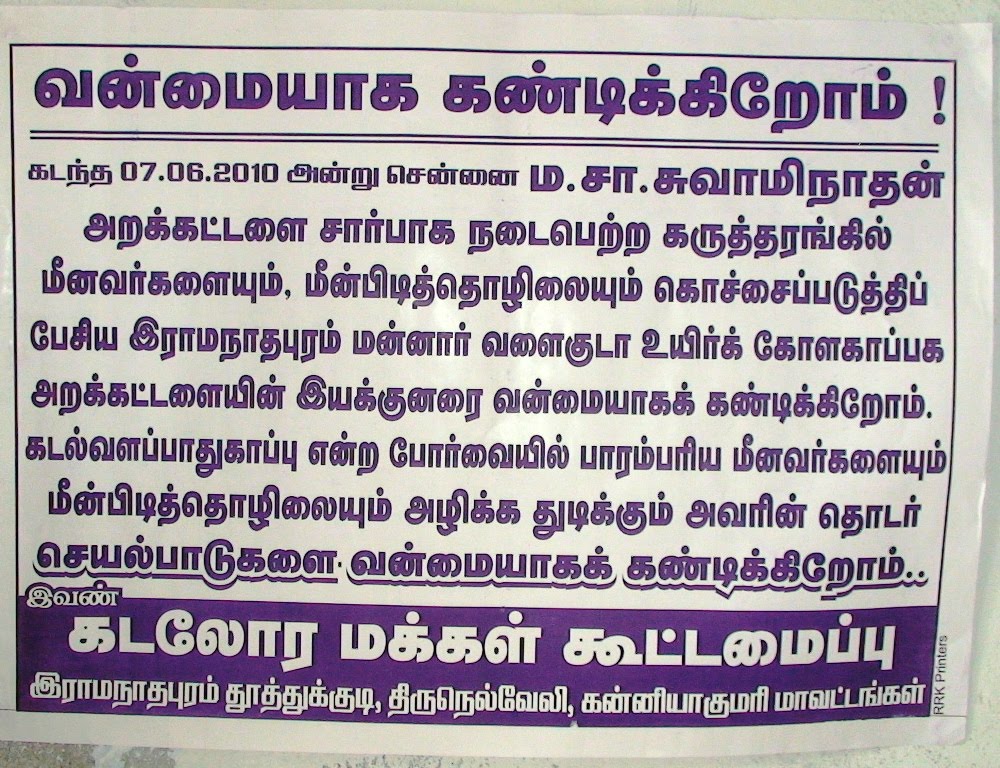
“Gulf of Mannar biosphere a neglected biodiversity hotspot”
Special Correspondent“Gulf of Mannar biosphere a neglected biodiversity hotspot”
Coastal communites smuggling sea horses, says official
CHENNAI: The Gulf of Mannar biosphere, the first marine biosphere in south, is one of the most neglected biodiversity hotspot, said Aruna Basu Sarkar, Chief Conservator of Forests and Director, Gulf of Mannar Biosphere Trust (GOMBRT) on Monday.Covering 360 km of coastal length spread over four districts and habitat for over 3,600 organisms was declared as a marine biosphere as early as 1989. It was still in a critical position, said Ms. Sarkar at a State-level Consultation on Community Agro-biodiversity Management held at M.S. Swaminathan Research Foundation.
While people would have to cultivate for products in other areas, the coastal villagers along the biosphere would have to just jump into the sea to get products worth Rs.500 to Rs.1000 everyday. “As it is difficult to find alternative livelihood options that matched the value of marine products, the villagers are reluctant to lead a life without depending on the biosphere,” she said.
The formation of the Trust and constant interaction with the locals prevented mining of coral reef but the coastal communities were still smuggling sea horses and sea cucumber. Despite booking cases against violators, the trade flourished as it was very lucrative. Now, the Trust has written to the Collectors concerned to book repeated offenders under Goondas Act, she said.
Dangerous nets
Besides, industries, without any regulations, were using the locals to smuggle 147 types of sea weeds and 13 variety of sea grass for their needs by paying no fee, Ms. Sarkar charged. The government had banned several dangerous nets but their use continued illegally. As the Forest Department has no powers to book the trawlers violating Marine Fisheries Regulation Act, the onus was on the Fisheries Department.
The four types of marine turtles, which used to breed on the shores of the biosphere, had now become casual visitors. Last April there were two cases of poaching of dugong each weighing 400 kg. But, the offender was allowed to go scot free without any investigation, she said. In a particular case, the president of the eco-development council happened to be a top smuggler of sea cucumber. .
Stating that conservation was still under buried condition in the marine biosphere, Ms. Sarkar said the critical condition raised issues of over-exploitation of marine resources, reduction in fish population and resultant food security for the local community.
On the positive side, Ms. Sarkar said the Trust has successfully trained self-help groups in alternative livelihood options reducing dependence on illegal money lenders, reduced drop-out rate in schools and has provid.
http://www.thehindu.com/2010/06/08/stories/2010060861210500.htm
Gulf of Mannar biosphere: official clarifies
M. Sundarakumar, I.F.S., Wildlife Warden, Gulf of Mannar National Park, writes:
This has reference to the news item “Gulf of Mannar biosphere a neglected biodiversity hotspot” (Tamil Nadu editions, Internet, June 8), which said that “last April there were two cases of poaching of dugong each weighing 400 kg. But the offender was allowed to go scot free without any investigation.”
A dead dugong was recovered at Rameswaram port on April 6 and another at Seeniappa Dharga on April 16. They were not poached. The Wildlife Warden, Ramanathapuram, conducted an interrogation at the site. No organs of the dugongs were found removed. Post mortem attributed the deaths in both cases to “respiratory and circulatory failure.” The department has not allowed any offender to go scot free as no offence was committed.
The report also quoted the Director of the Gulf of Mannar Biosphere Trust as saying that “conservation was still under buried condition in the marine biosphere.” The State Forest Department has implemented various protection and conservation schemes with the help of Centrally sponsored schemes. It has engaged 90 anti-poaching watchers. Between 2003 and 2008, 20 cases were registered. Between 2008 and 2010, 89 cases were registered and 120 people were arrested and remanded. A sum of Rs.4.60 lakh was collected as penalty. Patrolling and surprise checks are being carried out regularly and habitual offenders arrested and remanded. Smuggling of sea turtle and sea cucumber in Tuticorin Range has been arrested.
http://www.thehindu.com/2010/06/11/stories/2010061154291300.htm
Condemnation of Fisher people